


👋 Welcome to the first issue of The Admit Letter. Each Tuesday I’ll share one tactical framework, breakdown, or take to help you get into a top MBA program. No fluff, no upsell. Let’s get into it.
There’s a pattern I’ve watched play out hundreds of times.
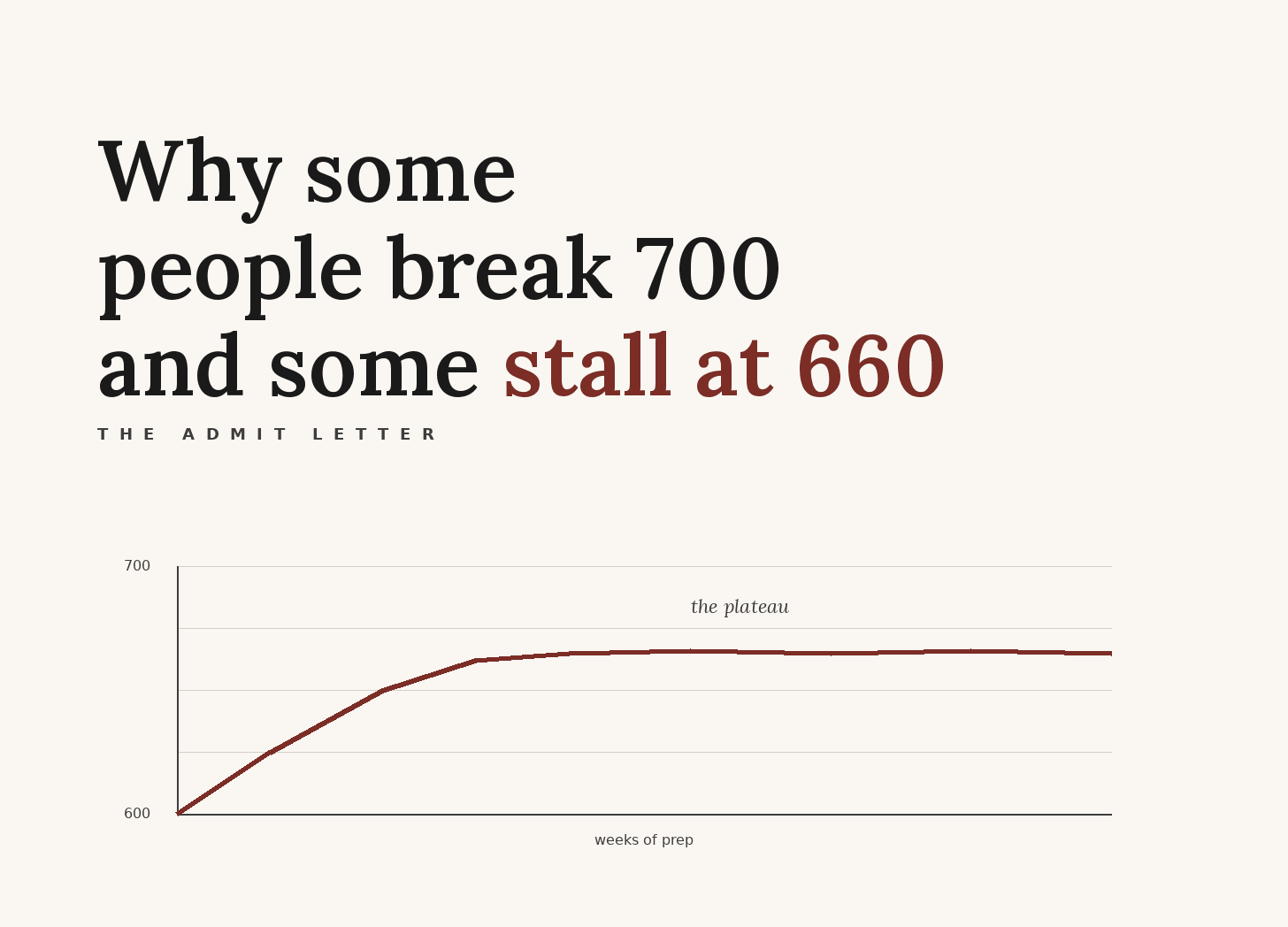
Someone preps for the GMAT for three or four months. They put in real hours. Their score creeps from a 600 diagnostic up to a 660. Then it stops.
Two more weeks of grinding . . . no movement.
Three more weeks, maybe a 670, but their last mock dipped back to 650.
They start asking around. Should they try a different course? Buy more questions? Take a break?
Almost always, the actual problem isn’t what they think it is.
By month three of prep, you don’t have a knowledge problem anymore. You know what a weighted average is. You know your modifier rules. You can do permutations in your sleep.
What you have is an execution problem.
You don’t know why you keep missing question 23 when you’re tired. You don’t know why your quant score drops when you’re under time pressure. You don’t know why you keep falling for the same trap answers.
More content won’t fix that. Targeted pattern recognition will.
And it takes about four focused weeks, not three more months.
Here’s exactly what those four weeks look like.
Week 1: Stop studying. Diagnose.
Take one full-length official mock under real conditions.
Don’t cram the night before. Don’t drink an extra coffee. Same start time as your actual test will be.
You’re not trying to hit a number. You’re trying to find out what’s actually breaking.
Then - and this is the part most people skip - spend the next three days reviewing it. Not studying. Reviewing.
For every question you got wrong, write a single line about why. Not the topic. The actual reason.
“Misread the question stem.”
“Ran out of time on the section.”
“Got tunnel vision on the trap answer.”
“Knew the rule, applied it backwards.”
You’ll start seeing patterns inside thirty questions. They’ll be more concentrated than you expect.
Most people, when they actually do this, find that 60 to 70 percent of their wrong answers cluster into two or three error types. That’s the gold.
This week feels like nothing is happening. That’s why most people skip it.
They’re wrong.
Week 2: Drill the failure, not the topic
Pick the top three error patterns from week 1. Just three. Drill 40 to 50 questions per pattern.
Here’s the part people get wrong: the drilling has to match the failure, not the surface topic.
If your pattern is “misreads under time pressure,” doing more verbal questions doesn’t help you. You’re not bad at verbal. You’re bad at reading carefully when the clock’s running.
That’s a different problem and it needs a different exercise. Like reading a tough RC passage at 1.5x your normal speed and forcing yourself to articulate the main idea before moving on.
One thing worth knowing: most prep courses are organized by section (Quant, Verbal, Data Insights), but real weaknesses cut diagonally across them. Your “misreading under pressure” problem shows up everywhere. The course can’t really diagnose it because it’s not a section, it’s a behavior.
Your error log can. Trust the log over the curriculum once you’re past the basics.
Week 3: Simulate, don’t study
Two full-length mocks this week. Both under real conditions.
Same start time as your test. No phone in the room. No snacks you wouldn’t have on test day.
Review each one within 24 hours using the week 1 method. One line per wrong answer, the actual reason, no excuses.
Your score will probably dip somewhere in the middle of this week. This is normal and it freaks people out every time.
You’re training endurance and pattern recognition at the same time, and that combination feels worse before it feels better. If you panic now and switch tactics, you’ll undo two weeks of work.
Stay in the boat.
Week 4: Taper
Three days before the test, stop doing new problems. Just review your error log.
Sleep eight hours every night. If you don’t normally drink caffeine, don’t start now.
The applicants who cram the last 48 hours consistently underperform their practice scores by 20 to 40 points. The ones who taper match or beat them.
I don’t know exactly why this is true. I suspect it’s a combination of cognitive fatigue and lost confidence when last-minute drilling goes badly. But the pattern is consistent enough to bet on.
Use this week for the boring stuff too:
Decide what you’ll wear
Decide what you’ll eat that morning
Plan how you’ll get to the test center
Pack your bag the night before
Routine eliminates decision fatigue. You want zero novel decisions in the hour before you sit down.
Three things that quietly kill scores
These don’t fit cleanly into the four-week structure, but they matter.
1. Mock test inflation. If you’re using third-party mocks, your score is probably a bit inflated. Sometimes by 20 points, sometimes by 50.
The only mocks that reliably predict your real score are GMAC’s official ones. You get six of them total — two free, four paid. Use them sparingly.
And whatever you do, don’t take one in the 48 hours before your real test. If it goes badly, you’ve torched your confidence right when you need it most.
2. Reviewing only wrong answers. Most people review what they got wrong.
Top scorers review every question they weren’t 100 percent sure about, including the ones they got right by guessing well. Lucky guesses this week become wrong answers next week. Review them now.
3. The “one more month” trap. If your score has been flat for three weeks, take the test.
You can always retake. You’re allowed up to five attempts in any 12-month period, with a 16-day wait between them. Schools see your highest score, not your average.
Most people who tell themselves “I just need one more month” end up telling themselves the same thing four months later. Sometimes the test is the cure for the plateau, not more prep.
One thing to do this week
If you’re prepping right now, do this:
Open a blank doc. Name it “Error Log.” Start writing one line per wrong answer. The actual reason. In plain English.
That’s it.
Just start. Do it for one week.
You’ll learn more about your weaknesses in seven days than most applicants learn in three months. It’s the highest-leverage habit in test prep, costs nothing, takes ten minutes a day, and almost nobody actually does it.
Next Tuesday: GMAT vs GRE for 2026 applicants. The data on what schools actually do with each score, why test-optional is more legitimate than it looks, and how to decide which test fits your profile.
If this was useful, forward it to one person who’s prepping. That’s how this newsletter grows.
And if you have a question about your own prep, application, or school list, hit reply. I read every email and the best ones turn into future issues.
- Sriram Krishnan
P.S. Got something specific you want me to tackle next? Reply and tell me. Reader questions shape what gets written.